Showing posts with label It... Came From the 50s. Show all posts

Sunday, 29 November 2015

IT!...Came From the 50s #5: The Beast From 20,000 Fathoms (1953)


The Beast From 20,000 Fathoms is a 1953 giant monster film. Directed by Eugene Lourie (Gorgo) the film stars Paul Hubschmid, Cecil Kellaway (Harvey) and Lee van Cleef (The Good, The Bad and the Ugly). The film features the pioneering work of special effects legend Ray Harryhausen (Mighty Joe Young, Clash of the Titans) in his first credited project.

Starting off in the Arctic circle, we are let in on a top secret project called "Operation Experiment" (rubbish secret name) in which Dr Nesbitt (Hubschmid) and his colleagues are studying the effects of atomic weaponry. As is often the case, the foolish experiments end up awaking a giant prehistoric lizard who decimates the science team and begins to work his way down the east coast of North America. After successfully convincing his superior commander (Van Cleef) and the world's leading paleontologist (Kellaway) of his discovery, a team is soon put together to stop the beast from destroying New York. However, aside from being gigantic and, let's face it, a double hard bastard, the lizard is also carrying lethal radioactive blood. This leads to a climax set on Coney island which not only requires the use of a roller coaster, but also a radioactive isotope to be shot into the throat of the creature and save humanity.

If this plot sounds familiar, it's because it's near identical to the very first Godzilla film which was released a little over a year after this film. In fact, The Beast not only helped to directly inspire Gojira (1954) but also the giant/atomic monster movies of the 50s and beyond, making it a very important film indeed. However, where Gojira would go on to spawn an iconic franchise consisting of no less than 27 sequels, The Beast came and went with little fanfare and it perplexes me why a sequel was never produced.

The plot is solid and the pacing is classical in it's "less is more" approach, favouring a strong mystery vibe rather than a "dinosaur smashing buildings up" approach. But when the smashing starts, it is a glorious sight...even to 2015 eyes! The combination of Harryhausen's inimitable stop motion work with front projection and an awful lots of extras running for their lives is surprisingly convincing and a lot of fun to watch. The clever twist of the creature's blood being radioactive, therefore necessitating a slightly smarter approach, is genius and I wished they'd perhaps spent a bit more time on this.

The Beast From 20,000 fathoms might be the more overlooked giant monster film when it comes to classics like Gojira and Them! (also 1954) and the "Rhedosaurus" may seem like the more bland creation to modern eyes but this is a truly iconic film with substance to back it up. Recommended viewing for any Godzilla/Kaiju fans, or indeed any fans of the legendary Ray Harryhausen, The Beast is representative of both of those things and I was certainly left wanting more.

***** 5 Stars

Have you seen the movie? What's your favourite giant monster movie?

Wednesday, 9 October 2013

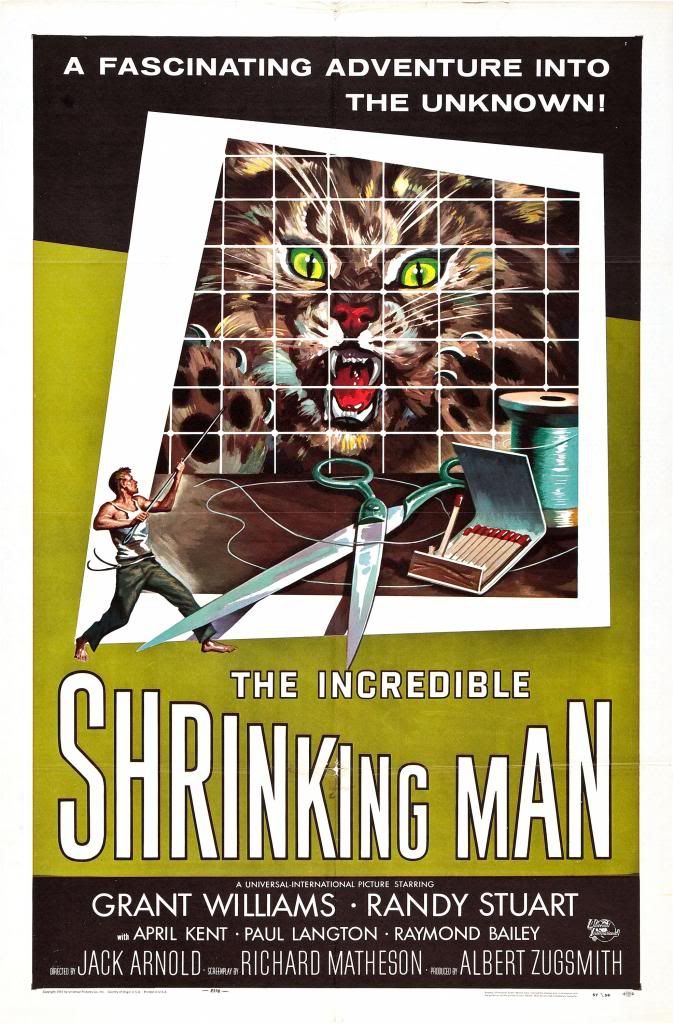
IT!...Came Frome the 50s #4 : The Incredible Shrinking man (1957)


The Incredible Shrinking Man is a 1957 science fiction film. Directed by Jack Arnold (The Creature From the Black Lagoon, It Came from Outer Space!) starring Grant Williams and Randy Stuart. The film is an adaptation of the novel "The Shrinking Man" by famous sci-fi author Richard Matheson (I Am Legend) and the screenplay was written by the man himself.

The film opens with the titular man Scott Carey (Williams), and his wife Louise (Stuart), enjoying a leisurely afternoon on his brothers boat when the couple encounter a mysterious mist on the open sea. Carey is later told that the mist was a radioactive cloud, and coupled with exposure to pesticides, this cloud starts to take serious effects on Carey shrinking him initially to the size of a dwarf and later to the size of a toy soldier. This causes particular problems when Carey becomes trapped in his own basement and is presumed dead by the outside world. Carey is forced into a fight for survival in a usually safe domestic environment as he faces the perils of his gigantic basement.

The Incredible Shrinking Man features some absolutely groundbreaking special effects for the time in the form of front projection and, of course, oversized household objects. This may sound silly and primitive now, but you really do get sucked into the larger than life world by the clever utilisation of a bowl-sized teacup here and a javelin sized pin there. It's exactly the same effect that I was fascinated by in Honey I Shrunk the Kids (1989) when I was a kid and you can really see what an influence The Incredible Shrinking Man (as well as many other 50s sci-fi movies) must have had on that film.

However, far from the madcap antics of Rick Moranis and his pint sized family, The Incredible Shrinking Man takes a far more earnest approach and existential tone in it's plot, presumably from the source material. The film asks profound questions around the existence, and significance, of mankind as well as the nature of masculinity and it's easy to imagine both themes striking a poignant chord with audiences of the 1950s. Like most 50s sci-fi films the film also makes a cautious statement against the perils of science and radioactivity, and seems to mix in religious belief as a competing ideology echoed in the final moments of the stunning closing monologue "to God there is no zero, I still exist!"

The Incredible Shrinking Man is one of the more restrained and subtle science fiction movies of the 1950s but undoubtedly one of the strongest. Like Gojira (1954) before it, the film places maximum emphasis on the message treating the matter as deadly serious allegory of science and progress. Essential viewing for fans of science fiction and the profound works of Richard Matheson.

**** 4 Stars

Have you seen The Incredible Shrinking Man? What do you think of the film's message?


Saturday, 12 May 2012

IT!...Came From the 50s #3: Invasion of the Bodysnatchers (1956)


Invasion of the Bodysnatchers is a 1956 sci-fi film adaptation of the 1954 novel of the same name. Directed by Don Siegel (Dirty Harry, Escape From Alcatraz) and starring Kevin McCarthy (Innerspace) and Dana Wynter (Airport). The film is regarded as one of the classic sci-fi movies of the era and has been remade 3 times.


The story is told from the perspective of Dr Miles Bennell (McCarthy) in the form of a flashback, complete with narration. Bennell is a GP in the small fictional town of Santa Mira, he starts to notice strange activity after his patients begin to accuse their loved ones of being impostors completely devoid of emotion. One such case is referred to him by romantic interest Becky Driscoll, who's cousin suspects her uncle of being an impostor and this leads them to Bennells friend Jack who finds a body bearing a suspicious resemblance to himself. The couple discover the towns inhabitants are being replaced by doppelgangers or "pod people" as part of an alien invasion and are left with no one to trust as they attempt to escape the invasion!


Invasion of the Bodysnatchers is no doubt a seminal work of science-fiction and one that most people are aware of in one incarnation or another, the main reason for it's success and longevity is it's surprisingly deep philosophical themes. Like many of it's contemporaries the film is an allegorical tale, not of war or science but of identity and trust.  This adds an interesting existential element to the film that was simply not seen in other sci-fi films of the era; what makes a person who they are? what makes us human? and most importantly how well can you really know someone. This is highly relevant due to the historical context of the film, being released in 1956 places it not only at the centre of the cold war but also at the centre of McCarthyism and this is epitomised in the films strong sense of paranoia and distrust.


 Atmosphere also plays a large part in the effectiveness of the film and creates a tension rarely seen in other science fiction/horror films of the day. The narration also works really well to flesh out the story and prevent any confusion over the body doubles and who's who and the subtle difference in the performances also helps to make this distinction. The design of the pod people is really well done and quite sinister considering the primitive level of special effects available, the lifeless bodies are born out of the pods covered in a bubble-like plasma and when they emerge have a shiny waxwork-esque appearance which is quite arresting. All the actors give suitably over-the-top performances throughout the movie's central crisis which rather than looking dated actually contributes to the films overall theme of mass hysteria.


When a film gets remade three times it's usually an indication of a compelling and timeless story and that's exactly what Invasion of the Bodysnatchers is. Pioneering and so relevant to the time in which it was made, the film is as thrilling and tense as I'm sure it was in 1956 and if you've ever seen any of the other versions I certainly recommend going back in time to experience the original.


5 Stars *****


Have you seen this film? Have you seen any of the remakes?

Friday, 13 April 2012

IT!....Came From the 50s #2: Them! (1954)


Them is a 1954 giant monster science fiction film. Directed by Gordon Douglas (The Little Rascals) starring James Whitmore (The Shawshank Redemption), Edmund Gwenn (Miracle on 34th Street) and James Arness (The Thing From Another World). The film is considered one of the pioneers of the atomic age monster movie.

The film opens with Sgt Peterson (Whitmore) and his partner investigating some local disturbances in the New Mexico desert including break-ins and murders. There are strange circumstances surrounding the crimes in that nothing is stolen except sugar and the only witness is a mute little girl. The FBI quickly send in agent Robert Graham (Arness) followed by father and daughter team Dr Harold (Gwenn) and Patricia Medford to aid in the investigation. This leads to the discovery that due to the testing of the atomic bomb in New Mexico, a new breed of giant radioactive ants has emerged to take over the world. After a Queen ant escapes from the nest and threatens to populate California with the oversized bugs, emergency meetings are called as the government declare marshal law in an attempt to wipe Them out!

Them! is truly a pioneering film of it's day, following on from the equally groundbreaking Beast from 20,000 Fathoms (1953),the contemporary Gojira (1954) and of course the revolutionary King Kong (1933). Opting for puppet-based mechanical monster effects, as opposed to rubber suits or stop motion, has caused the film to age really well and the fact that the creatures were hand-built, hand-operated creations is a feat of engineering. The sound effects are equally important, the iconic ringing noise that the ants make creates a kind of tinnitus effect for the viewer and builds up a real sense of dread for the arrival of the monsters (occurring about a third into the movie). As well as the creature noise it's also worth noting that the film employs the now standard Wilhelm Scream, created only three years earlier, in some of it's key action scenes.

The trouble with Them! is it's slow, really slow. The first 30 minutes of the film plays out as a painfully slow murder mystery and for the rest of the runtime action sequences involving the ants are kept to a frustrating minimum. This may well be due to the constraints of the technology and the budget however it's telling that the 94 minute running time feels like an awful lot longer, and at times the film can be quite boring. The acting however, is solid enough to fill these lulls in action with great performances from both Whitmore and Arness as the investigatory double act. My favourite performance though, is from Edmund Gwenn as the allegorical entomologist, every 50s sci-fi movie has these characters to preach against the perils of nuclear power, scientific experimentation etc but the difference is Dr Medford is really likeable. This produces a rather schizophrenic character that is both doomsayer and comic relief, as his bewildered exchanges with the younger characters genuinely bring a smile to the viewer.

Them isn't the best 50s science fiction film, or the best giant monster film but it did legitimately break new ground and paved the way for hundreds of monster movies such as Jaws (1975) as well as giant insect movies such as Starship Troopers (1997). If you can patiently sit through a bit of tedious sleuthing you'll be rewarded with some vintage 50s sci-fi action and the film rightfully takes it's place as one of the classics of that golden era.

4 Stars ****

What did you think of Them? Do you like "giant bug" movies?

Friday, 16 March 2012

IT!....Came From the 50s #1: Gojira (1954)


Gojira is a 1954 kaiju (giant monster) film produced by Toho studios. Originally released in Japanese with English subtitles, the film was re-released in America in 1956 with English dubbing and additional scenes under the title Godzilla, King of the Monsters!. Directed by Ishirō Honda and starring Momoko Kōchi, Akihiko Hirata and Takashi Shimura, the film follows the rampage of a giant radioactive lizard through the city of Tokyo. The film spawned a whopping 27 sequels spanning a 50 year period and remains one of the most iconic characters in Japanese culture.

The film opens (as many Godzilla films do) with a small fishing boat being attacked whilst out at sea. After another ship is sunk, mainland authorities and scientists soon flock to the small island of Odo to investigate. Amongst the investigators is Dr Yamane (Shimura) his daughter Emiko (Kochi) and her fiancé, and fellow scientist, Dr Serizawa (Hirata). Not long after the arrival of our protagonists, Odo island experiences a massive storm, at which point Godzilla reveals himself to the characters and the viewer. After some quick research, the official scientific opinion reached is that Godzilla is a giant lizard that has been mutated by nuclear radiation.


Comparitively, the folklore angle is that Japan is being punished by the Gods for meddling with nature, and experimenting with nuclear bombs. Either way Godzilla makes a break straight for Tokyo and, over the course of two nights, lays waste to the city (despite an ingenious electric pylon fence). Luckily Dr Serizawa has developed the deadly "oxygen bomb", an aquatic weapon designed to destroy the oxygen atoms in water and suffocate any nearby creatures. After seeing the destruction caused by the monster, all three characters head out to sea to confront a submerged Godzilla and put an end to the destruction.


A lot of people's impression of the Godzilla franchise is the inherent silliness of watching two men in rubber suits wrestle each other whilst smashing tiny buildings. The tone of the original film couldn't be further from that. A bleak and poignant allegory of nuclear technology, a mere 9 years after the events of Hiroshima/Nagasaki, Godzilla is punishment for man inflicting suffering on his fellow man. A particularly sombre moment occurs when Dr Serizawa is refusing to use his oxygen destroyer for fear of reprisals from the monster. However, he is convinced by seeing a news report on the television documenting Tokyo's devastation set to the eerie sound of a children's choir. When he uses the oxygen destroyer, he insists that all knowledge of the device be erased and Dr Yamane's final anti-nuclear monologue chills the viewer to the bone.


The design of the monster is absolutely timeless. The look of the suit, the atomic breath and the iconic roar all contribute to the impact of the film and the franchise's longevity. The action sequences are as impressive now as I'm sure they were in 1954. It's certainly quite obvious that the buildings and vehicles are miniatures, but the grainy black and white style and epic classical score are more than enough to help you suspend your disbelief. The film also paces itself well and firmly establishes the moral of the story by the time Godzilla unleashes his fury on the city, which makes it all the more dramatic. As with most foreign films, it is advisable to watch it subtitled to get the most engaging experience, as dubbing only has the ability to make the film seem like a parody of the genre.


I've only seen around a third of the 28 Godzilla films, and only in the last few years which makes me somewhat of novice with the franchise. I started with the original and it's still one of the best of the series and of the 50s science fiction era. Whilst the other films can be a lot of fun, none were able to deliver such a harrowing fable whilst simultaneously featuring a giant monster smashing up the landscape. Most of the Godzilla films have never gotten a DVD release in the UK but this one has, so go check it out and see where the legend began.


5 Stars *****


How many Godzilla films have you seen? Have you seen the original?